If you're like most pharmacy owners I speak to, you run a tight ship. You watch your purchases, you check your daily sales, and you pay your staff on time. But somehow, at the end of the month, your profit never seems to match the effort you put in.
This isn't a coincidence. There are three "silent" profit-drainers that are incredibly common in Kenyan pharmacies, and they rarely show up on a simple sales report. The worst part is that by the time you spot them, the money is already gone.
Here are the three biggest ways your pharmacy is likely losing money right now, and how you can stop it.
1. The Expiry That Happens Right Under Your Nose
This is the most common one. A batch of Coartem or Amoxil sits at the back of your shelf while you and your staff sell the newer stock you received last week. It's a simple mistake, but it's an expensive one.
By the time you realize your mistake, the old batch is a few weeks from expiry. You can't sell it, and the supplier won't take it back. That's pure profit—and cash you paid to your supplier—wasted.
The Solution:
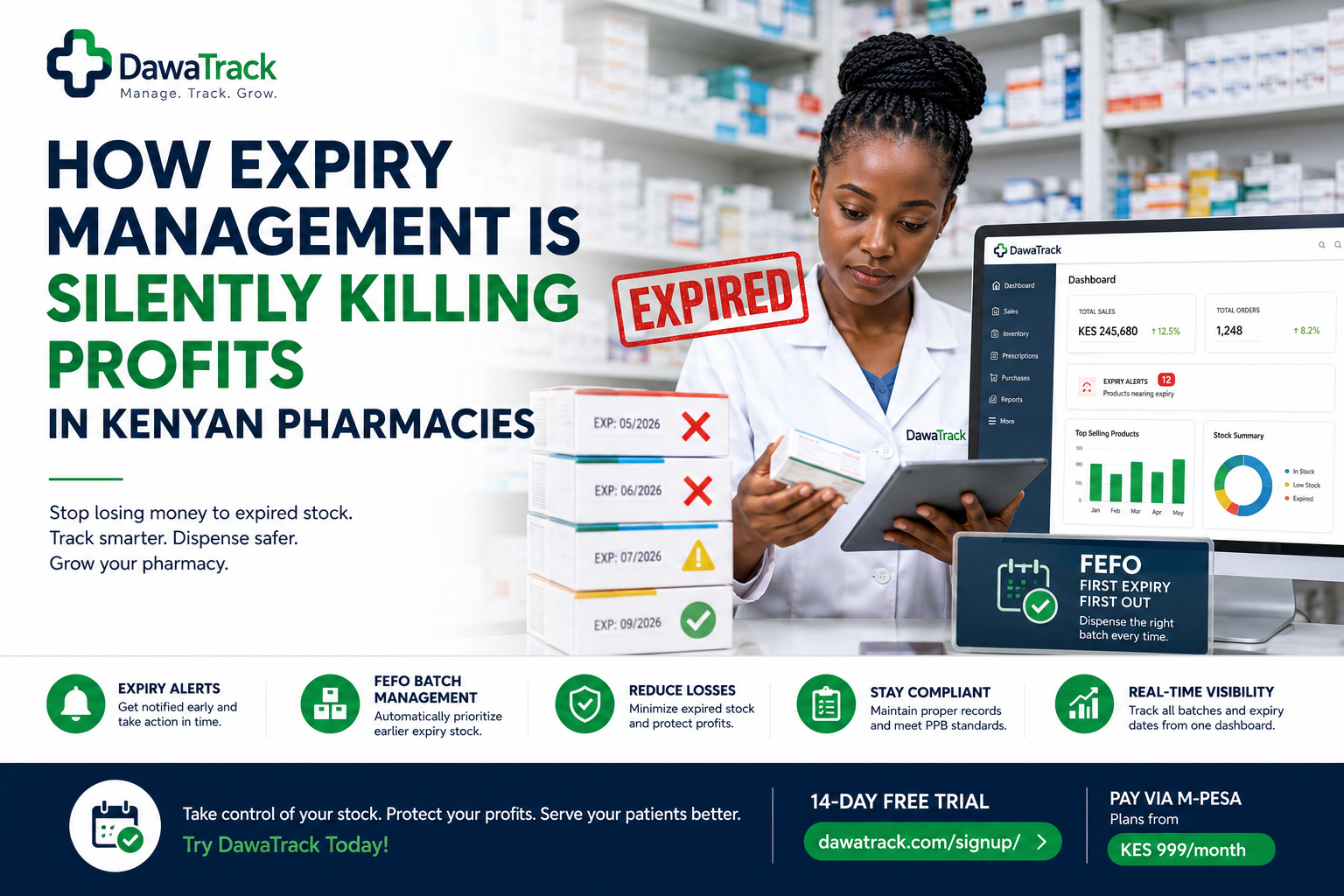
A simple "First Expiry, First Out" (FEFO) system ensures your staff sell the stock that will expire soonest, every single time. By the time a batch hits 30, 14, or 7 days to expiry, you get a clear alert to move it. You stop writing off stock you paid for and start selling it instead.
2. The M-Pesa Till That Never Matches
Your M-Pesa statement says you received KES 12,400. Your cash drawer has KES 10,200. And your stack of handwritten receipts tells a slightly different story. Now you have to spend an evening trying to figure out where the KES 2,200 gap is.
This isn't a one-time problem. It happens every week, or even every day. The hours you and your staff spend reconciling are hours you aren't serving customers or growing your business. That's a cost you don't see on any invoice.
The Solution:
A system that automatically matches every single M-Pesa payment to the sale that generated it saves you hours of manual work. When you scan a product at the counter, the customer gets the STK push, and the payment is reconciled instantly. Your books are always correct, and your "evening reconciliation" becomes a thing of the past.
3. The Branch You Can't See
If you're running more than one pharmacy, this one might hit close to home. Your busy branch in town is out of a key painkiller, while your quieter branch in the estate has an overstock of the same medicine. A customer walks into the town branch, doesn't find what they need, and leaves to buy from your competitor.
You only find out about the stockout when a staff member calls you, or worse, when you do a physical stock count at the end of the month. That's lost sales, wasted stock, and dissatisfied customers.
The Solution:
When you have one dashboard that shows you the live stock in every single branch, you can move stock from where it's sitting to where it's selling, instantly. You stop losing sales to stockouts and stop tying up cash in excess stock at other locations.
Stop Losing Money You Worked Hard to Earn
These three problems are not "costs of doing business." They are avoidable losses. The technology to solve them exists, and it's designed specifically for how Kenyan pharmacies operate.
The best part? Solving just one of these problems can easily pay for the solution. As we like to say at DawaTrack: you don't need your losses to disappear for it to pay for itself. You need them to drop at all.
If you're tired of seeing your hard-earned profit slip away through these silent drains, it's time for a change.
Ready to see how it works?
Start your free 14-day trial of DawaTrack today—no credit card required. Or, book a quick, no-pressure demo and we'll show you exactly how we can help you stop losing money.