If you own or run a pharmacy in Kenya, you have probably heard the word eTIMS more times in the last two years than you would like. Maybe from your accountant, maybe from a supplier asking for a compliant invoice, maybe from a fellow pharmacist in a WhatsApp group asking, "wacha kwanza - are we supposed to be doing this?"
This guide explains what eTIMS actually means for a retail pharmacy, in plain language, without the legal jargon. It is written for busy pharmacy owners, not tax consultants.
(One note before we start: KRA requirements evolve. This guide reflects the position as we understand it at the time of writing - always confirm the latest details on the official KRA website or with your tax advisor.)
What is eTIMS, in one paragraph?
eTIMS (electronic Tax Invoice Management System) is KRA's system for capturing sales invoices electronically, at the moment a sale happens. Instead of KRA relying on the records you compile at the end of the year, every invoice is transmitted to KRA as you trade. The goal from KRA's side is simple: every business sale in Kenya should generate an electronic tax invoice.
Does eTIMS apply to my pharmacy?
In almost every case, yes. eTIMS obligations extend to businesses in general - including small businesses that are not VAT-registered. Whether you run a single chemist in an estate or a chain of branches, if you are trading, KRA expects your sales to be captured electronically.
Two things make this especially real for pharmacies:
- Your suppliers care. Wholesalers and distributors increasingly need compliant documentation across the chain, because expenses without valid eTIMS invoices create tax-deduction problems for the businesses claiming them. That pressure travels down the supply chain to you.
- Pharmacies are record-heavy businesses already. Between PPB requirements, controlled-substance registers and daily sales, you are already keeping records. eTIMS adds a tax layer on top of that - and the pharmacies that struggle are the ones whose sales records live in counter books and memory.
The real problem: reconstruction
Here is what we see over and over when talking to pharmacy owners about eTIMS:
The pain is not the rules themselves. The pain is reconstruction - sitting down at filing time and trying to rebuild weeks or months of sales from a counter book, a stack of M-Pesa messages, and whatever the attendant remembers. Reconstruction is slow, it is stressful, and it produces records that do not quite match reality. That mismatch is exactly what attracts questions.
The fix is not working harder at filing time. The fix is capturing every sale properly, once, at the moment it happens - so that compliance becomes a by-product of how your pharmacy already works, not a separate crisis every few months.
Your options for complying
Broadly, a pharmacy has a few routes:
1. KRA's own free tools. KRA provides simplified options aimed at smaller businesses, including portal-based and phone-based invoicing. These work, and free is free - but they are manual. Someone must key in each sale, on top of serving customers. In a busy pharmacy at lunchtime, "I'll enter it later" becomes "I'll enter them all on Sunday," and you are back to reconstruction.
2. Standalone eTIMS software from certified integrators. These generate compliant invoices well, but most are generic invoicing tools. They do not know what a batch number is, they do not track expiries, and they do not reconcile your M-Pesa. You end up running two systems: one for tax, one (usually a counter book) for the actual pharmacy.
3. Pharmacy management software that captures sales properly at the counter. This is the route we believe in, for an obvious reason: a pharmacy's sales record should be created by the sale itself. When your point of sale logs every transaction with the item, quantity, price, payment method and time - automatically, while you serve the customer - your eTIMS obligations stop being a separate task. The record already exists, structured the way tax records need to be.
How DawaTrack approaches this
DawaTrack is pharmacy management software built in Kenya, for Kenyan pharmacies. On the compliance side, it works like this:
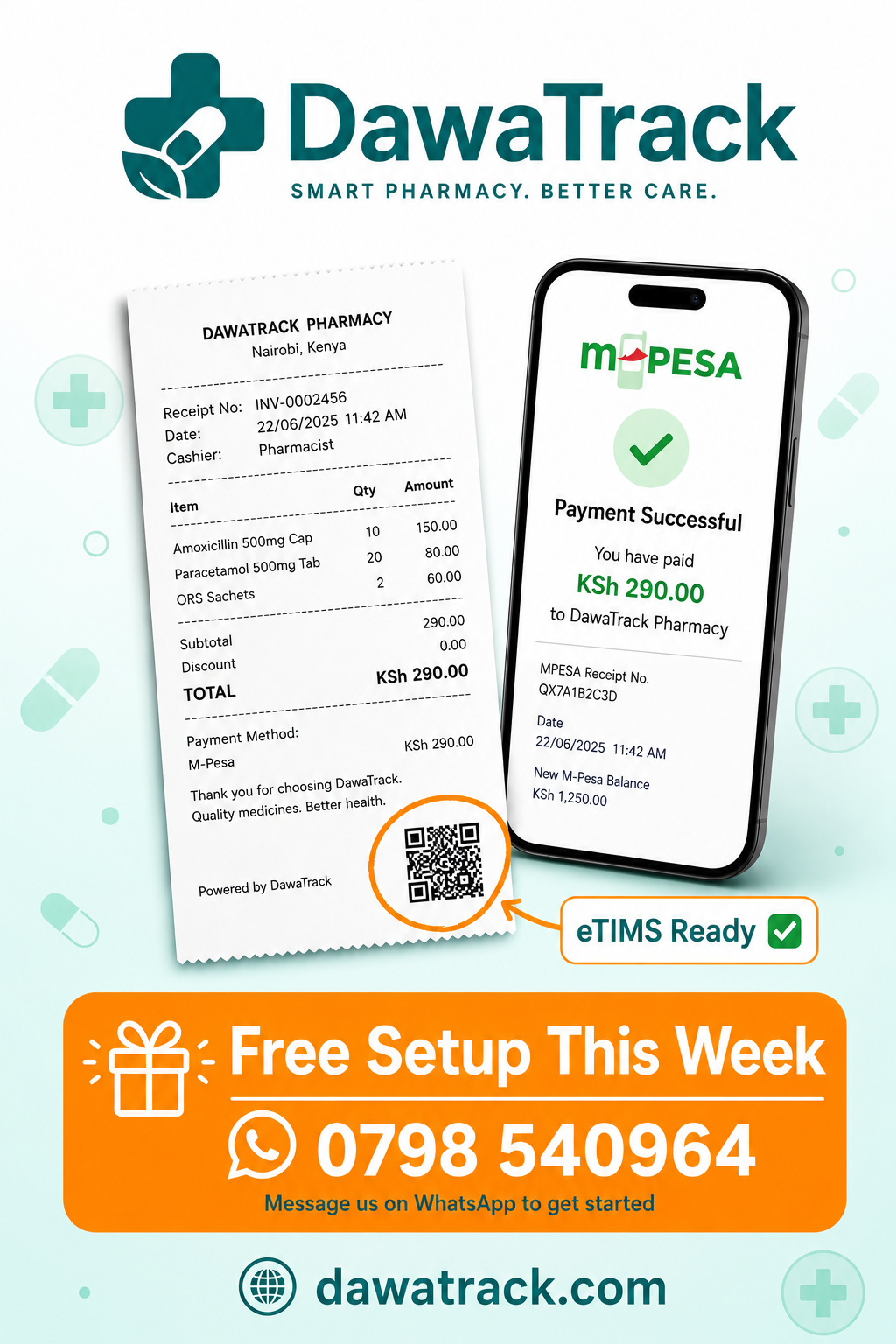
- Every sale is logged at the moment it happens - product, quantity, price, payment method - so your sales records are complete and eTIMS-ready by default, not reconstructed later.
- M-Pesa reconciliation means your electronic money trail and your sales records tell the same story. Mismatches between M-Pesa statements and declared sales are one of the fastest ways to invite scrutiny; DawaTrack surfaces them daily instead of at year-end.
- Batch-level inventory with expiry tracking keeps your stock records tight - which matters both for PPB and for a clean picture of purchases versus sales.
- It runs on a phone or computer, and most pharmacies are fully set up within a day or two.
We will be straightforward, because that is how we prefer to operate: how the final invoice transmission to KRA happens depends on your setup, and we walk each pharmacy through the right configuration for their situation during onboarding. What DawaTrack guarantees is the part most pharmacies get wrong - complete, structured, real-time sales records - so that eTIMS compliance sits on a solid foundation instead of a counter book.
Frequently asked questions
My pharmacy is small and I am not VAT-registered. Do I still need to worry about eTIMS? Yes eTIMS obligations are not limited to VAT-registered businesses. KRA provides simplified options for smaller traders, but "small" is not an exemption from electronic invoicing.
Can I just keep using my counter book? Your counter book can remain part of how you work, but on its own it does not satisfy electronic invoicing requirements and it makes filing season painful. The goal is for your electronic record to be created automatically at the point of sale.
What happens if I ignore eTIMS? Beyond potential penalties, the practical consequences arrive through the ecosystem: business customers cannot use non-compliant invoices, suppliers tighten documentation requirements, and mismatches between your M-Pesa records and declared sales become harder to explain over time.
Does moving to software mean retraining my whole staff? It should not. Good pharmacy software makes the sale faster to record than a counter book, not slower. Our honest experience: attendants pick up point-of-sale basics in under an hour, and a busy pharmacy is fully switched over within a day or two.
Where do I start if I am completely behind? Start capturing today's sales properly today do not wait until historical records are perfect. A clean record going forward is worth far more than a perfectly reconstructed past, and it immediately stops the hole from getting deeper.
The bottom line
eTIMS is not going away, and the pharmacies that handle it comfortably all share one habit: they capture every sale properly at the moment it happens. Everything else filings, supplier documentation, KRA questions becomes dramatically easier once that foundation exists.
If you would like to see how DawaTrack does this for pharmacies like yours, we offer a free 14-day trial — no card needed, set up in a day, with support on WhatsApp throughout.
👉 Start your free trial at dawatrack.com or message us on WhatsApp for a free demo we are happy to explain your eTIMS options even if you never use our system.